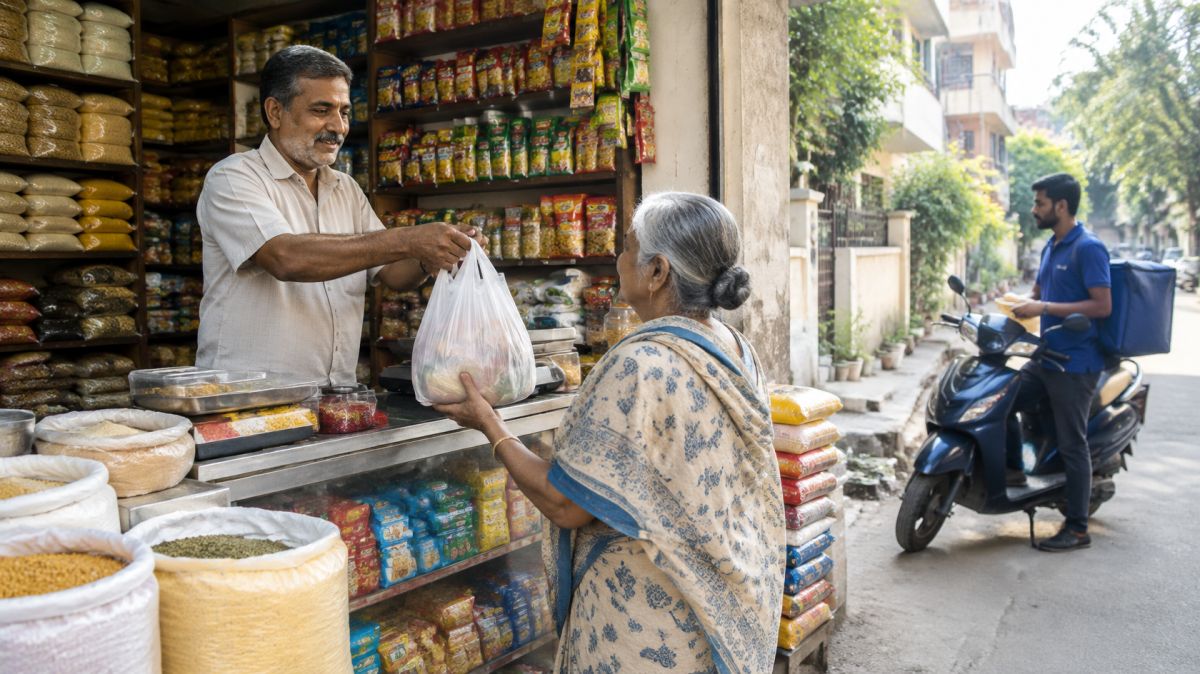
First, what you have that no app has
Before changing anything, be clear about your strengths. These are the reasons families have come to you for years, and they are worth protecting.
- You know your customers. Their names, what they buy, which brand of atta the family likes, which uncle needs sugar-free biscuits.
- Trust. Udhaar for a regular in a tight month, or “pay tomorrow” when someone forgot the wallet.
- Small and loose quantities. 100 grams of jeera, one packet of Maggi, a single egg, two lemons.
- Local and seasonal items that big catalogues don’t carry: the local brand of namkeen, festival puja items, the right pickle mango in season.
- Help, face to face. An exchange without a form, a return without a call centre, advice on what to buy, and a delivery boy who knows every gali.
- Reliability. You’re open when the network is down, when it’s raining, when the app says “no slots”.
- Your money stays in the mohalla. Your staff, your suppliers and your family all live here.
The aim is not to become an app. It’s to keep all of this, and remove the small reasons customers have to go elsewhere.
Understand why customers order elsewhere
Talk to a few regular customers who have started using apps. Most give one of these reasons:
- “I didn’t have time to come.” They needed home delivery or quick ordering.
- “You didn’t have it.” A brand or item they wanted wasn’t in stock.
- “There was an offer.” A discount on a specific item.
- “It was late at night.” They needed something after you closed.
You can fix the first two completely, and soften the other two. The rest of this guide shows how.
Three kinds of shopping, three ways to serve
Most kirana customers shop in three ways. Serve each one on purpose:
- Daily top-up: milk, bread, eggs, vegetables, snacks. They want it fast and close. Be quick at the counter and on WhatsApp.
- Monthly ration: atta, rice, dal, oil, sugar, masale, cleaning items. They want it complete and dependable. Offer a monthly list service (below).
- Emergency: “guests are coming”, “the child needs it for school tomorrow”. They want someone who picks up the phone. Be that person.
Make ordering as easy as an app
WhatsApp orders
Let customers send a list, a voice note or a photo of a handwritten list. Reply with the total and the time it will arrive. Put a “Save this number for orders” card on the counter. See the full guide on selling on WhatsApp without commission.
Delivery rounds
Delivering every order the moment it arrives is tiring and costly. Fixed rounds are easier to run and customers quickly get used to them. For example:
- Order by 10 am → delivered by 12
- Order by 4 pm → delivered by 6
- Order by 7 pm → delivered by 8:30
Keep a minimum order for free delivery (say ₹300) and a small fixed charge below it. Make exceptions for elderly customers and emergencies; that kindness is part of why people choose you.
Monthly ration service
This is one of the strongest things a kirana can offer, and apps rarely do it well.
- Ask regular families if they’d like their monthly ration delivered on a fixed date, like the 1st or after salary day.
- Write down their usual list once: brands, sizes, quantities.
- Two days before, send the list on WhatsApp: “Your monthly list for 1st: Aashirvaad atta 10 kg, Fortune oil 5 L, toor dal 2 kg… Any changes?”
- They reply with changes. You pack it, deliver it, and collect payment.
You can plan your stock better, the customer never has to think about it, and they’re unlikely to switch for a small discount somewhere else.
Payments that are easy for everyone
- UPI QR at the counter and on the delivery boy’s phone. A sound box that announces payments helps on busy days.
- Always check the money has arrived before handing over goods; fake screenshots are common.
- Cash is still fine. Many elderly customers prefer it.
Udhaar, done kindly and clearly
Credit for regulars is a big reason people stay with their kirana. It only goes wrong when records are unclear.
- Keep one page or one record per family, with date, items and amount.
- Decide a limit for each family that you’re comfortable with.
- Once a month, send the balance politely on WhatsApp:
Namaste Verma ji. Your balance for October is ₹2,340 (details below). Please clear it when convenient. Thank you for always shopping with us!
Clear records protect the relationship. Most families pay happily when they can see exactly what they bought.
Stock smarter
- Keep an “asked for” notebook at the counter. Every time a customer asks for something you don’t have, write it down. If three people ask in a month, stock it.
- Know your street. A lane full of students and young workers buys instant noodles, snacks, cold drinks and small packs. A lane of joint families buys big packs of atta, oil and rice. A lane with many elderly people needs sugar-free and health items.
- Track fast and slow items. Once a month, look at what sat on the shelf untouched. Reduce it. Slow items lock up money and space.
- Never run out of the top 50 items. Milk, bread, eggs, the two popular atta brands, oil, sugar, tea, biscuits. A customer who finds these missing twice starts looking elsewhere.
- Plan festival stock early. Puja items before Navratri, dry fruits and gift packs before Diwali, sewai before Eid, cake ingredients before Christmas.
- Stock local makers. Home-made pickles, papad, local namkeen and ghee from nearby families give customers a reason to come to you, and help local home businesses grow.
Make the shop pleasant to visit
- Light and cleanliness. A bright, swept shop with dusted shelves feels fresher than a dim one, even with the same stock.
- Price tags on shelves for common items. Customers trust what they can see.
- Easy-to-reach daily items near the counter; heavy bags lower down.
- A small space to stand out of the sun and rain while you pack the order.
Be easy to find
New families move into your area every month. Make sure they find you before they find an app:
- Put your shop on Google Maps, with your delivery area and hours.
- Keep your phone number big and clear on your board.
- Put a QR code on the counter so people can save your WhatsApp in one scan.
- Give a small card with your number to every new face. Welcome them: “New in the area? We deliver.”
Be honest about prices and offers
- Sell at or below MRP, always. One customer who catches overcharging tells ten others.
- Keep everyday items close to the market price where you can. You don’t need to match every app discount, just avoid being far off on the basics.
- Run small, real offers: a free item on monthly orders above a set amount, a festival combo pack, or extra loyalty for long-time customers.
- Tell customers what you do better: “We deliver small orders too”, “We have the brand you like”, “Exchange anytime”.
Look after your regulars
- Elderly customers: deliver even small orders, carry heavy bags, check on them if they haven’t come in a while. Their children notice.
- Remember names and preferences. “Your usual Tata tea?” is something no app says the same way.
- Small gestures still matter: a little extra dhaniya, a toffee for the child, a festival greeting on WhatsApp.
- Fix problems without arguing. A wrong item exchanged with a smile keeps a family for years.
Work with the shops around you
You don’t have to do everything alone. Send customers to the chemist or the sabzi wala next door when you don’t have something, share a delivery boy with two other shops, and run a festival offer together. Shops that support each other keep the whole street busy, and a busy street brings customers to every shop on it. Read how shops in one market grow together.
A simple 30-day plan
- Week 1: Set up WhatsApp Business with your catalogue of top items. Put a “Save our number for orders” card and QR on the counter. Start the “asked for” notebook.
- Week 2: Put your shop on Google Maps or fix your existing listing. Announce your delivery rounds and minimum order.
- Week 3: Offer the monthly ration service to your 20 most regular families. Clean up udhaar records and send polite balances.
- Week 4: Look at the notebook and your slow items. Add what people asked for; reduce what doesn’t sell. Talk to two neighbouring shops about sharing delivery or a festival offer.
You don’t have to beat the apps at their own game. You have to be the shop your street can’t do without.
This guide is general information to help local shops. It is not professional advice.
