Why work as a team?
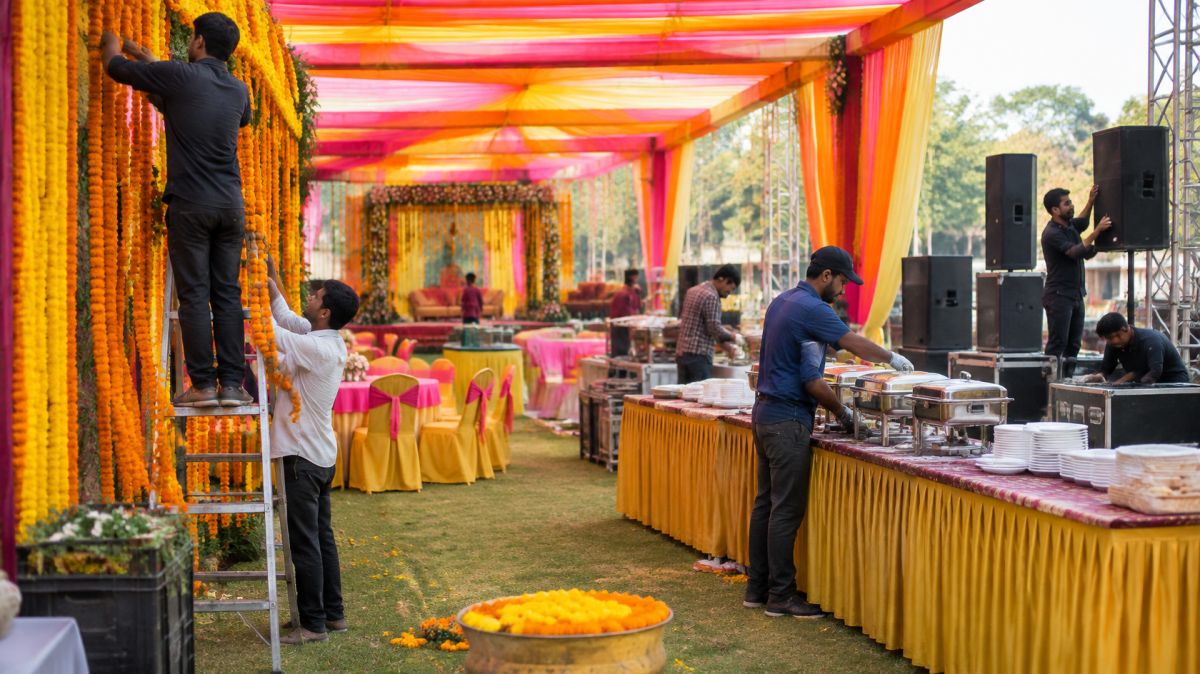
For the family, a wedding is one event. For vendors, it is usually ten separate businesses who meet for the first time on the day. That’s where most problems come from: the decorator arrives after the caterer has set up, the DJ’s power load trips the venue’s supply, the photographer doesn’t know when the varmala is.
A local team of vendors who know each other solves this:
- Families trust a recommendation from a vendor they’ve already chosen.
- More bookings for everyone through referrals.
- Smoother weddings: vendors who have worked together know each other’s needs.
- Stronger together against big outside companies, while keeping the money in your town.
- Help in emergencies: a generator, an extra cook, a backup photographer.
Who belongs in the team
- Venues: banquet halls, farmhouses, marriage gardens, community halls
- Caterers and halwais
- Tent house, decorators and florists
- Lights and sound, DJ, band, dhol
- Photographers and videographers
- Mehendi and makeup artists
- Pandit ji, qazi or other priests
- Tailors and boutiques for bridal and family outfits
- Sweet shops for mithai and gift boxes
- Card printers and gift hamper makers
- Transport: cars, buses, ghodi and baggi
Step 1: Build a trusted circle
Start with vendors you’ve already worked with and respect. Look for people who:
- arrive on time and keep their word
- are honest about prices and don’t surprise families with extra charges
- treat families and other vendors politely
- handle problems calmly on the day
Begin with five or six vendors from different services (one of each), so you’re not competing with each other. Add more slowly as trust grows.
Make a WhatsApp group for the team, and keep a shared list: name, service, area, price range, phone number, and a link to their page or photos.
Step 2: Refer each other, honestly
When a family books your venue and asks “Do you know a good caterer?”, you can now give two or three names you trust, instead of “anyone is fine”.
- Give two or three options where possible, not just one, so the family feels free to choose.
- Only recommend people you would hire for your own family’s wedding.
- Be open about referral arrangements. If you receive a referral fee, tell the family. Hidden commissions that raise the family’s cost damage everyone’s name. Many teams simply refer each other with no fee, knowing it comes back.
- Follow up: after the wedding, ask the family how the vendor you recommended did.
Step 3: Offer simple joint packages
Many families, especially for smaller functions, love a ready package. Put together a few clear options with fixed prices, for example:
- Engagement / roka package: venue for 100 guests + veg menu + basic decor + photographer (4 hours)
- Mehendi and sangeet package: decor + DJ + mehendi artist + snacks menu
- Wedding day package: venue + catering per plate + tent and decor + lights and sound
- Birthday / anniversary package for the off-season
Write down exactly what’s included in each, the price, what costs extra, and which vendor provides what. Each vendor still bills the family for their own part, or one vendor collects and pays the others, as agreed in writing.
Packages are optional. Families can always choose vendors one by one.
Step 4: Share dates and availability
A family usually fixes the date and venue first. Knowing which team members are free on that date saves everyone time.
- Each vendor keeps their booked dates updated in one place: a shared sheet, a pinned message in the group, or their own online calendar.
- Before recommending, check that the vendor is free on that date and session.
- During peak muhurat dates, plan early: which vendors can handle two events, and who can help whom.
Step 5: Agree fair terms
Clear terms protect both families and vendors. Each vendor should give the family a simple written quote or agreement covering:
- date, time, place and number of guests
- exactly what is included, item by item
- total price, advance amount and when the rest is due
- what happens if the date changes or the event is cancelled
- what costs extra (overtime, extra guests, travel, special items)
Within the team, agree on a few shared standards: everyone gives written quotes, everyone is honest about extra charges, nobody undercuts another member by running them down to a family.
Step 6: Run the wedding day as one team
Before the day
- Make a simple event-day timeline with the family: arrival of baraat, varmala, pheras or nikah, dinner timings, vidaai.
- Share it with all vendors in a group for that wedding, along with one contact person from the family.
- Agree on setup times so vendors don’t block each other: tent and decor first, then lights and sound, then catering counters.
- Check power needs together: decor lights, DJ, catering equipment, AC. Arrange a generator if the venue supply isn’t enough.
On the day
- Choose one coordinator from the team (often the venue or decorator) whom other vendors check in with.
- Keep phones on and reachable; reply quickly in the wedding group.
- Help each other: a spare extension board, an extra pair of hands, a backup speaker.
- Stay calm and respectful in front of the family, whatever happens behind the scenes.
After the day
- Clear up your area on time and leave the venue as you found it.
- Thank the family and ask for a review. See getting customer reviews.
- Meet as a team briefly: what went well, what to fix next time.
Step 7: Get found together
- Every vendor should have a Google Maps profile with photos of real events.
- Show your work: photos and short videos of setups, menus and real weddings (with the family’s permission).
- Make a shared team page or a simple brochure with all vendors and their contacts.
- Tag each other in posts about shared events, so families can see the whole team.
- Join local listings where families search for vendors by city.
Step 8: Plan for the season
- Before the season: update prices together, plan packages, and service equipment.
- Peak dates: share staff and equipment where possible; no one should turn down a family because one item is missing.
- Off-season: offer birthday, anniversary, kitty party, corporate and religious event packages to keep work coming.
Keep the team healthy
- Two vendors in the same service? Fine, as long as both are trusted. Recommend both and let families choose.
- A member lets a family down? Talk privately first. If it happens again, stop recommending them.
- Payment disputes between vendors? Agree in writing who collects what, and settle within a fixed number of days after each event.
- Meet a few times a year, not just in the WhatsApp group.
A wedding is one of the biggest days in a family’s life. When the town’s vendors work as one team, that day goes smoothly, and the money the family spends stays with local businesses who will be there for the next wedding too.
This guide is general information to help local shops. It is not professional advice.
