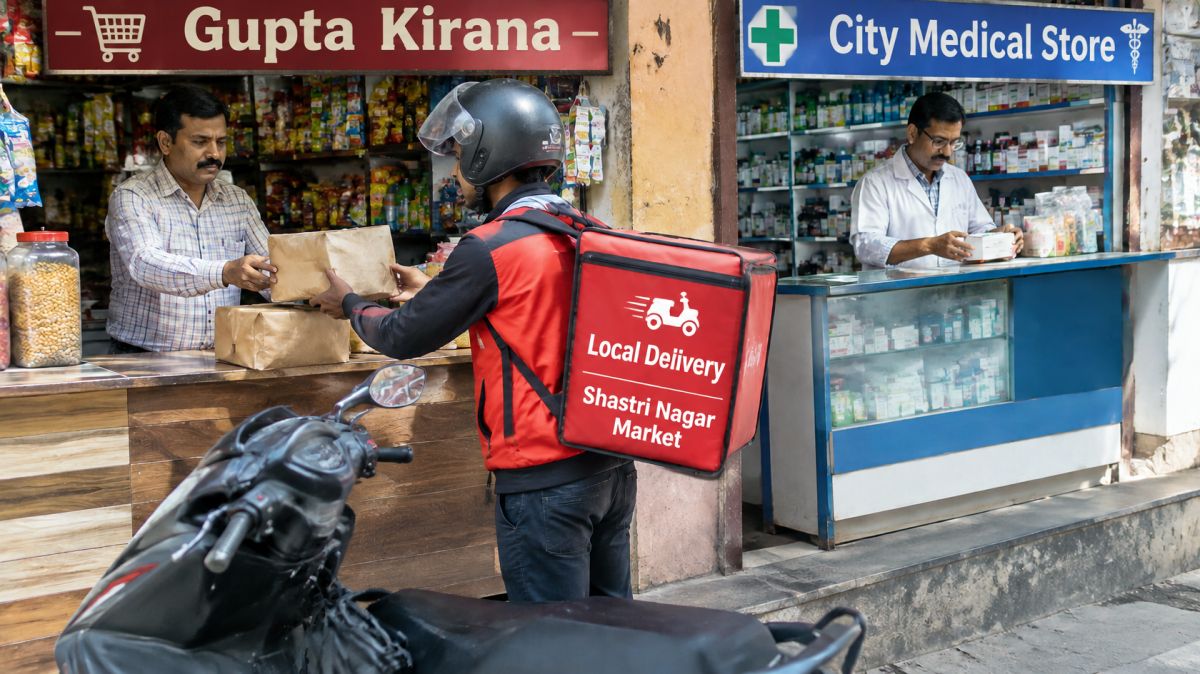
Why share delivery?
For a single shop, delivery is hard to make work:
- A full-time delivery person is costly if there are only 10–15 deliveries a day.
- The shopkeeper or a helper leaves the counter to deliver, and customers at the shop wait.
- Delivery apps charge commission on every order, often on customers who already knew you.
When nearby shops that sell different things share one delivery person, there are enough orders to fill the day, and each shop pays only part of the cost. A kirana, a chemist, a sweet shop, a bakery and a stationery shop on the same street are a natural team.
Step 1: Find your delivery partners
- Talk to two or three nearby shopkeepers you trust (your market group is a good place to start).
- Choose shops that sell different things, so you’re not competing for the same customer.
- Agree on a shared delivery area: for example, within 3 km of the market.
- Check that your delivery days and hours roughly match.
Step 2: Choose a model
A shared delivery person
One person, hired together, picks up from each shop and delivers in rounds. Good when you have a steady number of orders across the shops every day.
Taking turns
Each shop’s helper does delivery rounds on certain days or times, carrying orders for all shops in the group. Good when orders are fewer, or when shops already have helpers with some free time.
A local delivery partner
A local young person with a two-wheeler who works for several shops, paid per delivery. Good for a start, or for extra help during festivals.
Many markets start with turns or a per-delivery partner, and move to a shared full-time person as orders grow.
Step 3: Plan delivery rounds
Rounds are the key to making delivery affordable. Instead of running out for every order, the delivery person leaves at fixed times with all pending orders.
- Round 1: orders by 10 am, delivered by 12
- Round 2: orders by 1 pm, delivered by 3
- Round 3: orders by 5 pm, delivered by 7
- Round 4 (optional): orders by 7:30 pm, delivered by 9
Announce the round times to customers in each shop, on WhatsApp and on your Google profile. Customers quickly plan around them.
Plan the route
- Divide the area into two or three zones, and deliver zone by zone.
- Collect all orders from the shops 15 minutes before the round starts.
- Pack each order with the shop name, customer name, address, phone and amount clearly written.
- Keep a short list for each round: order, shop, address, paid or cash to collect.
Step 4: Split costs fairly
Agree on how to share the cost before you start, and write it down. Common ways:
- Equal share: each shop pays the same monthly amount. Simple, and fair when shops have similar order numbers.
- Per delivery: each shop pays a fixed amount for every order delivered. Fair when one shop has many more orders than others.
- Fixed plus per delivery: a small fixed monthly share, plus a per-delivery amount. Balances both.
Also agree on fuel (included in pay or paid separately), phone and data costs, and festival bonuses. Settle accounts on a fixed date every week or month, using the round lists as the record.
Step 5: Decide delivery charges for customers
- Free above a minimum order (say ₹300 or ₹500), small fixed charge below it.
- Same rules across all shops in the group, so customers aren’t confused.
- Combine orders: if a customer orders from the kirana and the chemist in the same round, charge delivery once.
- Kindness for the elderly and emergencies: many shops deliver medicines and essentials to elderly customers free. It builds loyalty that no app can match.
Step 6: Handle money safely
- Encourage UPI payments to each shop’s own UPI ID before or at delivery, so the delivery person carries less cash.
- If collecting cash, write the amount for each order on the round list, and hand over cash with the list at the end of every round.
- For UPI at the door, the customer pays the shop directly (not the delivery person’s number), and the shop confirms on the phone before the goods are handed over.
- Count and settle cash with each shop the same day.
Step 7: Look after your delivery person
- Fair, regular pay on a fixed date, and a festival bonus.
- Safety: a helmet, a valid licence and vehicle papers, and no pressure to rush in traffic.
- Rain and heat: a raincoat, a covered box for goods, water and breaks in summer.
- Respect: they represent all your shops at the customer’s door. Treat them as part of the team.
- Hire locally: a young person from the area knows the lanes, and the job keeps money in the community.
Make sure the delivery person is polite, honest and reliable, and that customers have a shop number to call if anything goes wrong.
Step 8: Keep customers happy
- Confirm every order on WhatsApp with the round time and total.
- Send a short message when it leaves: “Your order is on the way with Ravi, reaching in 20 minutes.”
- Be on time. Reliability matters more than speed.
- Handle mistakes quickly: a missing item goes in the next round, with an apology.
- Ask for feedback now and then, and fix what customers mention.
Tools you need (mostly free)
- A WhatsApp group for the shops and the delivery person, to share orders for each round.
- A notebook or shared sheet for round lists and accounts.
- WhatsApp Business at each shop for orders. See selling on WhatsApp.
- Google Maps on the delivery person’s phone for new addresses.
- Bags or a delivery box with all the shops’ names and numbers printed on it: free advertising on every round.
Common problems and fixes
- One shop sends many urgent orders between rounds? Agree that urgent extra trips are paid by that shop.
- Too many orders in one round? Split the area or add a round at busy times.
- Delivery person leaves? Keep one or two backup local riders you can call, and keep round lists so a new person can learn quickly.
- Disagreements over costs? Go back to the written agreement and the round lists. Review the split every three months.
A simple start in 2 weeks
- Day 1–3: agree with two or three shops on the area, the model, round times and the cost split. Write it down.
- Day 4–7: find a delivery person (or set the turns), set up the WhatsApp group and round list.
- Day 8: announce delivery to customers in all shops, with round times and charges.
- Day 8–14: run the rounds, note problems, and meet at the end of week two to adjust.
Shared delivery lets small shops offer what big apps offer, without the commission, and with a delivery person who knows every customer’s gate.
This guide is general information to help local shops. It is not professional advice.
