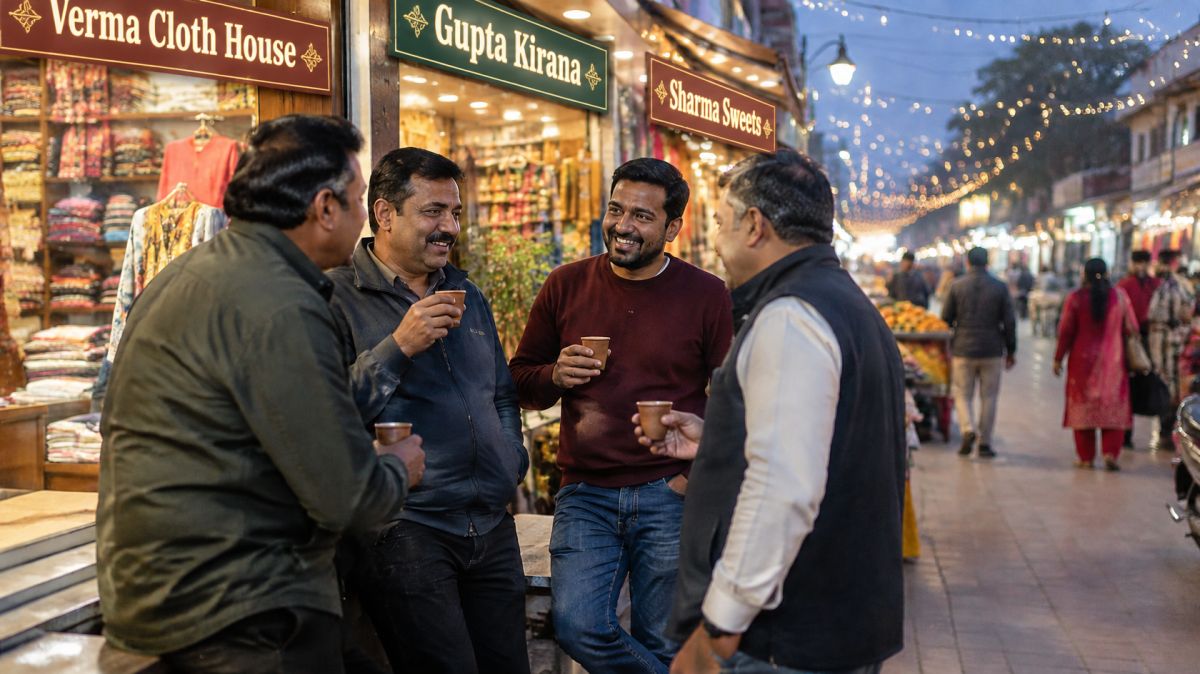
Why working together works
Think about why people go to a mall: everything is in one place, it’s clean, there’s parking, there are lights and events, and they know what to expect. A good local market can offer all of that, plus things a mall never can: shopkeepers who know you, fair prices, and the feel of your own town.
No single shop can make a market clean, safe, well lit and famous. Together, the shops can. And when the market as a whole gets busier, every shop in it gets more customers walking past its door.
What shops gain
- More visitors to the market, from farther away
- Customers sent to you by neighbouring shops
- Lower costs on things you all need, like delivery, security and cleaning
- A stronger voice with the nagar nigam, police and electricity department
- Festivals and events no single shop could afford
- Help when something goes wrong: a theft, a fire, a medical emergency
Step 1: Start with a small core group
Don’t try to get every shop on board on day one. Start with three to five shopkeepers you already trust, ideally different kinds of shops (a kirana, a sweet shop, a clothes shop, a chemist). Shops that sell different things find it easier to help each other first.
Your first meeting
Meet for half an hour, over chai, after closing or before opening. Keep it simple:
- What problems do we all face? (Parking, lights, cleanliness, theft, few visitors on weekdays…)
- What is one small thing we can do together in the next month?
- Who will start the WhatsApp group and invite others?
- When do we meet next?
Pick one small thing and do it well. Early success brings others in.
Step 2: One WhatsApp group for the market
Make a group for shopkeepers only (not customers). Choose one or two people to manage it. Pin a short set of rules, for example:
Market group rules: 1) Only market matters: safety, power cuts, events, suppliers, help needed. 2) No forwards, jokes or political messages. 3) No selling to each other or ads. 4) Be respectful, even when we disagree. 5) Urgent safety alerts: write “URGENT” at the start.
What the group is good for
- Safety alerts: a suspicious person, a pickpocket, a fake-note warning.
- Power cuts and water supply updates.
- Supplier tips: who gives good rates on carry bags, who repairs freezers.
- Planning: festival decorations, market cleaning day, joint offers.
- Help: “Can someone watch my shop for 10 minutes?” “Anyone have change for ₹500?”
Step 3: Send customers next door
This is the simplest, most powerful habit a market can build.
“We don’t have it, but Gupta ji two shops down does.” The customer remembers that you helped instead of just saying no. Gupta ji remembers too, and sends people your way. Over a year, this goodwill adds up to a lot of customers.
Make a “who sells what” list
Write a simple list of every shop in the market: name, what they sell, phone number, and where they are (“third shop after the temple”). Share it in the group and keep a printed copy at each counter. Update it when shops open or close.
Even better, turn it into a market map image and put it on everyone’s WhatsApp status before festivals.
Step 4: Plan the year together
Festivals and seasons are when markets win or lose customers. Plan them together, a month in advance. Some ideas through the year:
- Makar Sankranti / Lohri / Pongal: kite, til and gajak stalls; a small kite day for children.
- Holi: colours, sweets, thandai; a safe, organic-colours corner.
- Eid: late-night market, sewai and attar stalls, lights.
- Raksha Bandhan: rakhi and sweet combo offers across shops.
- Navratri / Durga Puja / Ganesh Chaturthi: puja items, decorations, dandiya night if space allows.
- Diwali: a “market week” with the whole street lit up, joint offers, longer hours.
- Christmas and New Year: cakes, lights, a small Santa corner for children.
- Wedding season: a combined “wedding shopping” list across clothes, jewellery, sweets, decor and gifts.
- School reopening: stationery, uniforms, bags, shoes; a joint “back to school” offer.
Ideas that work across shops
- Lights and decorations for the whole street, paid for together. A lit-up market draws people from other areas.
- A shared offer: “Show a bill of ₹1,000 from any market shop and get a free sweet box at Sharma Sweets.” Shops take turns giving the treat.
- A small Sunday-evening mela for families: a magician, a drawing competition, a band. Families come, stay and shop.
- Joint pamphlets or one WhatsApp message with all the market’s festival offers, instead of every shop making its own.
If you plan a lucky draw or prize scheme, keep it simple and check local rules first; some states have rules about prize schemes.
Step 5: Get the whole market online
Customers search before they step out. If half your market doesn’t show up on Google Maps, people may think there’s nothing there.
- Hold a “Google Maps day”: one morning where younger shopkeepers help others create or fix their Google Maps profiles, about 15–20 minutes per shop.
- Use the same market name everywhere, like “Begum Bridge Market”, in every shop’s address and description. Then a search for the market brings up all of you.
- Make one market page or Instagram account that posts festival plans, new shops and offers, and links to each shop.
- Encourage every shop to take WhatsApp orders (see selling on WhatsApp), so customers who can’t come still buy from the market.
Step 6: Share costs
Many costs are cheaper when shared, and some things are only possible together.
- Delivery: one delivery boy shared by three shops, with fixed rounds. Each shop pays its share.
- Security: a night guard or a few CCTV cameras covering the whole street.
- Cleaning: a sweeper for the common area, and dustbins outside shops.
- Bulk buying: carry bags, packing boxes, cleaning supplies, LED bulbs from one supplier at a better rate.
- Repairs and services: a trusted electrician or AC mechanic on call for all shops, at an agreed rate.
- Signage: one common market gate board or direction signs from the main road.
Step 7: Make the market pleasant
- Cleanliness: agree that each shop keeps the space in front of it clean, and hold a monthly cleaning morning.
- Parking: mark a two-wheeler area, keep the road clear, and avoid parking your own vehicles in front of shops all day.
- Lighting: shops leave their front lights on till a set time, so the street feels safe in the evening.
- Footpaths: keep goods within your shop line, so people can walk comfortably.
- Toilets and drinking water: even one clean public facility makes families stay longer. Ask the local body together.
Step 8: Speak with one voice
Street lights, broken roads, overflowing drains, encroachment, power cuts: a letter signed by thirty shops gets more attention than one shopkeeper’s complaint.
How to write to the local body
- Agree on one clear problem per letter.
- Say where, since when, and how it affects people (customers, elderly, women’s safety, business).
- Ask for one specific action: “repair the 4 street lights between the temple and the chowk”.
- Attach photos, and get as many shopkeepers as possible to sign with shop names and phone numbers.
- Submit it in person, keep a received copy, and follow up politely after two weeks.
Keep it fair: money and decisions
- Agree on contributions in advance: a fixed amount per shop per event, or a small monthly amount for shared costs.
- Write down every rupee: who paid, what was spent, with bills. Share the account in the group after each event.
- Rotate responsibilities so the same two people don’t do all the work.
- Decide together at meetings, and accept the majority view on small things.
- Keep politics and personal fights out. The group is for the market.
When shops disagree
- Two shops sell the same thing? That’s normal. Compete on service, stay friendly, and remember that a busier market brings more customers to both.
- Someone doesn’t want to pay? Don’t force it. Show results; most join once they see the benefits.
- An argument in the group? Move it to a face-to-face talk over chai. Written arguments get worse.
Formalising later
You don’t need to register anything to start. A WhatsApp group, regular meetings and clear accounts are enough for most markets. Later, when you’re dealing with authorities often or holding shared money, registering a market association (for example as a society) helps. Ask a local CA or lawyer about the right form for your state.
Start with three or four shopkeepers you already trust, and one small project. When others see it working, they join.
This guide is general information to help local shops. It is not professional advice.
